By Jana Nicol
2024 is going to be such an exciting year for UDL enthusiasts - it's the 40th anniversary of CAST, and the highly anticipated UDL Guidelines 3.0 will be rolled out as part of the UDL Rising to Equity initiative! I was fortunate to attend the CAST annual symposium in 2021 and participated in focus groups in which we discussed the UDL Guidelines and possibilities for updates to them. It seemed at the time that the new UDL Guidelines could end up looking quite different from the UDL Guidelines 2.2, in order to help identify and better address systemic barriers to equitable learning and outcomes for all learners.
If we compare the CAST UDL Guidelines 1.0 (2009) and the CAST UDL Guidelines 2.2 (2018), shown below, at a quick glance we can see that the basic structure of the document has remained the same. Checkpoints are grouped into Multiple Means of Engagement, Multiple Means of Action and Expression, and Multiple Means of Representation; which align with the affective networks/the why of learning, the recognition networks/the what of learning, and the strategic networks/the how of learning. It will be interesting to see how it takes shape in 2024!
CAST UDL Guidelines 2009 and 2018:
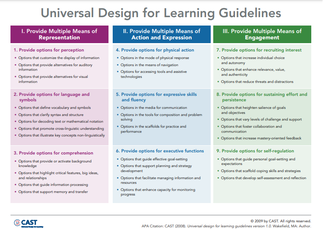 CAST UDL Guidelines 1.0 (2009) | 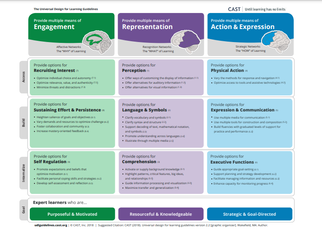 CAST UDL Guidelines 2.2 (2018) |
The Multiple Mean(ing)s of Representation
It's interesting how language evolves over time. I first started to learn about Universal Design for Learning in 2010, when the UDL Guidelines 1.0 were in use. At that time, the word Representation to me would have been thought of mainly in terms of accessibility. In the planning stages for any lesson, these are just a few questions I would ask myself when considering ways to provide Multiple Means of Representation:
- Am I ensuring that information is presented in ways that students can access it? Is it an appropriate reading level? Am I reviewing vocabulary in this text/lesson with words/pictures/experiential learning?
- Am I using an FM system to address the needs of students who have hearing impairments, auditory processing difficulties, or struggle with attention?
- Am I including information visually, in multiple ways (e.g. text, pictures, multimedia) to reach struggling readers, English language learners, or those who may need supports for memory or executive function?
I still ask myself these questions, because representing information to students in ways that meet their needs is going to improve learning outcomes for everyone. But my thinking about Representation has evolved since then - it is no longer just about accessibility, it is also about inclusion. In addition to the questions already posed, when providing Multiple Means of Representation, I may also ask:
- How can I model respect for inclusion and diversity to increase everyone's sense of belonging in the learning environment?
- To what degree can my students see themselves and their families represented in texts used in the learning environment?
- Whose knowledge and ways of knowing are given priority in the education system? How can we represent and honour multiple ways of knowing, including Indigenous knowledges, in the curriculum?
I am hopeful that the UDL Guidelines 3.0 will find a way to address the Multiple Mean(ing)s of Representation in the educational context. How can we better remove barriers, not only within classrooms, but also within educational systems and structures, to improve learning outcomes for everyone? How can we move beyond accessibility to inclusion and equity?